The History of Korean Soju
The History of Korean Soju:
Why Did Soju Become Korea’s Representative Alcoholic Drink?
Koreans drink a lot of soju,
yet it seems that not many people actually search for the history of soju
or ask why Koreans came to drink so much of it.
Whether you like it or hate it,
soju has already become one of the drinks most closely associated with Korea.
Personally, I’m on the “hate it” side.
The diluted soju we drink today is not simply a continuation of an ancient tradition.
More precisely, modern diluted soju is largely the result of
industrialization, government policy, and economic changes
that took place from the mid-20th century onward.
(The National Archives of Korea explains that after the Grain Management Act was implemented in 1965,
traditional distilled soju declined significantly while diluted soju became dominant.)
To understand why Koreans mainly drink soju today,
and how it became so widespread,
there are several things we need to look at.
1. What Was Korean Alcohol Like Before Soju Became Dominant?
Before modern diluted soju became widespread,
Korea had a diverse and complex drinking culture based largely on the fermentation of rice.
Alcohol was not simply a beverage.
It was part of culture and everyday life.
Makgeolli, cheongju, yakju, and traditional distilled soju.
Traditional soju was made differently from today’s diluted soju.
It was made by fermenting grains and then distilling the fermented liquid.
Even makgeolli itself was not a single type of alcohol.
There were many varieties depending on how the fermentation process was carried out.
A single fermentation was called danyangju.
If additional fermentation starter and ingredients were added to an already fermented batch,
it was called iyangju.
And if this process was repeated again,
it was called samyangju.
Even the makgeolli we commonly think of today existed in a surprisingly wide variety of forms.
2. Why Did Korean Alcohol Change?
Korea experienced colonial rule in the early 20th century,
war, and then rapid industrialization.
After the 1953 armistice, Korea faced severe food shortages.
As a result, the government restricted the use of rice in order to secure food supplies.
According to materials from the National Archives of Korea,
policies restricting grain consumption had been implemented since the 1950s.
Then, in 1965, the Grain Management Act restricted the production of pure-grain alcohol,
leading to an increase in alcoholic beverages made with alternative ingredients instead of rice.
Yes.
Eventually, a new form of alcohol emerged.
People still had to drink something, after all.
That was diluted soju, made by mixing industrial alcohol with water and various additives.
Industrial alcohol, or spirits (주정) in the Korean liquor industry,
is a colorless, transparent liquid produced by fermenting starch-based ingredients
such as rice, barley, sweet potatoes, or tapioca,
and then distilling and refining the resulting alcohol to a concentration of at least 85% alcohol by volume.
The method of simply diluting this alcohol with water,
lowering its alcohol content,
and adding ingredients to create its flavor
was much simpler and more efficient than the traditional method of fermenting grains and then distilling them.
In fact, diluted soju began being mass-produced after
a mechanized soju factory was established in Pyongyang in 1919,
but it expanded significantly into the form
we recognize today following the implementation of the Grain Management Act in 1965.
(National Archives of Korea)
As a result,
production costs became very low,
and it was highly suitable for mass production.
Distribution was also easy.
At a time when Korea was beginning its rapid industrial development,
people who worked hard all day naturally needed an inexpensive and easily accessible alcoholic drink.
Soju gradually became part of everyday life.
There were also advantages from the government’s perspective.
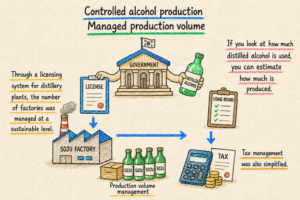
The government could control production by regulating the production of industrial alcohol.
A licensing system for alcohol-spirit factories also made regulation easier.
Because the amount of industrial alcohol used could provide a rough indication of production volume,
tax collection and management became relatively simple as well.
The government also required wholesalers to distribute local soju within their respective regions,
creating a regional monopoly structure.
In fact, in 1976, the government reorganized 254 soju companies across the country
and introduced a “local soju protection regulation” designed to protect regional soju producers.
(National Archives of Korea)
Many small-town soju producers disappeared,
but as a result, some have argued that the policy was beneficial
because it prevented a small number of companies from completely monopolizing the national market.
Representative Regional Soju Brands
Seoul / Gyeonggi – Jinro, Chamisul
Busan – Daesun, C1
Gyeongsangnam-do – Muhak, Good Day
Daegu / Gyeongsangbuk-do – Kumbokju, Chamssoju
Jeollanam-do – Bohae, Ipsaeju
Jeju – Hallasan
Gangwon – Kyungwul
(later absorbed by a major liquor company)
3. Why Did Soju Become Such a Dominant Drink in Korea?
From the 1990s onward, regulations related to the alcohol industry gradually began to loosen.
But by then, the market structure had already become firmly established.
People had already grown up drinking diluted soju.
They drank it when they became adults.
They drank it when meeting friends.
They drank it at company dinners after getting jobs.
By then, it had already been part of Korean culture for a long time.
It was inexpensive,
easy to find almost anywhere,
and socially accepted.
As a consequence,
traditional liquor producers had already lost much of their production systems,
distribution networks,
and continuity of technical knowledge.
At the same time, as the Korean economy grew rapidly,
imported alcoholic beverages such as whisky and wine entered the market,
making it even harder for traditional Korean alcohol to find its place.
4. Why Is Traditional Korean Alcohol Coming Back Now?
Today, Korea’s traditional alcohol market is slowly growing again.
But this is not simply a restoration of the past.
It is being reinterpreted in new ways.
As the value of Korean identity, or “Made in Korea,” has increased,
traditional Korean alcohol has begun to be recognized once again as a cultural product.
Even younger generations who do not actively seek out traditional culture
sometimes rediscover traditional alcohol while looking for something “a little different”
from what everyone else is drinking.
However, there are still problems that need to be solved.
A break in traditional fermentation techniques, including nuruk
Distillation techniques
A weak distribution system
A lack of strong brand structures
There is still a long way to go.
Conclusion
Modern diluted soju cannot simply be considered a traditional Korean alcohol.
More precisely, it is closer to an alcoholic drink shaped by historical circumstances.
Today’s diluted soju was created through poverty, industrialization, and government policy decisions.
And it came at the expense of traditional Korean alcoholic beverages.
Even so, interest in traditional Korean alcohol is growing again today.
More small-scale breweries and distilleries are appearing,
and new approaches are being explored.
I think of this as
the story of Korean alcohol being written again from the beginning.
And I think that’s a good thing.
Am I being too negative about diluted soju?
Maybe.
But I was also someone who genuinely enjoyed drinking soju.
If you’re a foreigner reading this,
I almost want to show you the atmosphere that only soju can create.
You don’t need anything fancy.
You don’t necessarily need samgyeopsal,
kimchi jjigae,
or an entire table filled with Korean food.
Because
soju can be enjoyed almost anywhere,
and with most kinds of food.
Some drinking veterans have it with a boiled egg from a convenience store
after a hard day’s work.
Another drinking veteran has it with a fried egg,
trying to force himself to fall asleep.
Some even drink it with ice cream.
All three of them might need to see a doctor,
but anyway, soju is
not a drink reserved only for special occasions.
It’s an everyday drink.
So if you want to understand why Koreans drink this alcohol with their meals,
rather than trying to recreate a perfect Korean dinner,
try having a glass of soju with the ordinary meal you normally eat.
You might just experience a little bit of Korea
right where you are sitting.
P.S. Drinking soju can be part of Korean culture.
But drinking soju every day is not Korean culture.
That’s simply alcohol dependence or addiction.
You need to see a doctor.
Wine Goes in a Wine Glass. Soju Goes in a Soju Glass.
5. Frequently Asked Questions (FAQ)
Why is soju so popular in Korea?
Soju became popular because it was inexpensive and easy to obtain,
and because industrial mass production and distribution systems helped spread it widely.
It is not simply because it tastes good.
Is modern soju a traditional Korean alcohol?
No.
Traditional Korean alcohol was generally made through fermentation or distillation of grains such as rice.
Modern diluted soju is closer to an industrialized alcoholic beverage that developed during the mid-20th century.
The National Folk Museum of Korea also describes modern diluted soju as an alcoholic beverage made by diluting ethanol
and adding flavorings, sweeteners, and other ingredients.
What is modern soju made from?
Modern diluted soju is made using industrial alcohol (ethanol), water, and, depending on the product, sweeteners and other additives.
Why did traditional Korean alcohol decline?
Food policies and regulations, industrialization,
and the loss of production and distribution infrastructure all played a role.
In particular, restrictions on the production of pure-grain alcohol following the implementation of the Grain Management Act in 1965
contributed to a significant decline in traditional distilled soju and the expansion of diluted soju.
Does diluted soju have a higher alcohol content than whisky?
No.
Whisky generally has a higher alcohol content than diluted soju,
and its production method and aging process are also completely different.
Why do Koreans drink soju with food?
Soju was inexpensive and easily available,
and as it became integrated with drinking habits that developed during Korea’s industrialization,
it established itself as an everyday drink consumed alongside meals.
What is Korean drinking culture based on?
Korean drinking culture has been strongly influenced by workplace culture,
group drinking traditions,
and the widespread availability of inexpensive alcohol produced through industrial mass production.