The History of Cheese and Butter in Korea
Why Does Korea Have So Little Tradition of Butter and Cheese?
The History of Cheese and Butter in Korea
Why Is It So Hard to Find High-End Made-in-Korea Cheese and Butter?
Some people assume that Korea simply lacked the technology or knowledge to
produce butter and cheese like Europe or the United States.
I can’t completely deny that, but let me explain why.
In fact, it was not simply a matter of technology or ability.
Korea developed under very different historical, agricultural, and cultural conditions.
In this article, we’ll look at why dairy products such as butter and cheese
did not naturally become part of traditional Korean food culture.
Joseon Dynasty: Milk Was an Extremely Rare Resource
There Was No Dairy-Focused Livestock System
During the Joseon Dynasty, cattle were not raised primarily for milk and meat as they are today.
They were mainly used as working animals for agriculture.
Because there was no established dairy farming system,
the number of cattle was naturally limited as well.
And as a result,
Milk Was a Very Rare and Limited Food
Milk was mainly consumed by the royal court and certain upper-class groups,
or used in limited forms such as being mixed into porridge.
Milk itself was so scarce that there was
naturally very little surplus milk available for experimentation with fermentation or food processing.
So it was even more difficult for butter- or cheese-making techniques to develop naturally.
Why?
Because butter and cheese require much more milk than you might expect.
As a general guideline, around 10 liters of milk may be needed to produce 1 kg of cheese,
while more than 20 liters of milk may be needed to produce 1 kg of butter.
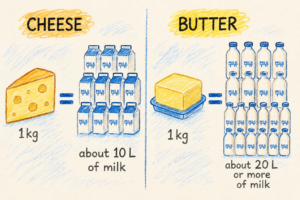
Of course, the amount varies depending on the type of cheese, production method,
and fat content of the milk.
But in an environment where milk itself was already scarce,
it would have been difficult to develop a culture of regularly producing and eating these foods.
Early 20th Century to Mid-Century:
A Period of Interrupted Development
Colonial Period (1910–1945)
This was the period of Japanese colonial rule.
During this time, Korea’s agricultural and industrial systems were heavily controlled from outside,
leaving very limited room for an independent dairy industry to develop.
Then Korea gained independence.
But soon after,
Post-War Devastation (1950s)
Yes, the Korean War happened.
After the war, Korea faced extreme poverty and severe food shortages.
There simply wasn’t enough food to get through everyday life.
Milk and dairy products were close to luxury goods.
Much of the industrial infrastructure was also destroyed.
At this stage,
survival itself took priority over developing diverse foods or new food-processing technologies.
1960s–1970s: The Beginning of Modern Dairy Farming
Focus on Basic Nutrition
The government now began to play a more active role.
At the time, an important goal of the dairy industry was
providing basic nutrition to the population through milk and powdered milk.
Providing formula for newborn babies was also important,
and improving the overall nutritional condition of the population was a priority.
That doesn’t mean butter and cheese were not being produced at all.
According to Seoul Milk’s official history,
butter production began in 1964, and cheese production began in 1973.
However, Korea’s dairy industry at the time did not have the capacity to
develop around a wide variety of aged cheeses or high-end butter like Europe.
Producing milk reliably and making it available to the population came first.
The Beginning of Korean Cheese: Imsil Cheese
In the 1960s, Belgian-born Father Didier t’Serstevens began raising goats in Imsil,
Jeollabuk-do, as a way to help increase the income of local residents.
When it became difficult to sell the goat’s milk, he began using it to make cheese.
According to the Encyclopedia of Korean Culture,
Imsil cheese production began under Father Didier t’Serstevens in 1966 and later developed
as local residents learned European cheese-making techniques.
In 1969, they also produced Camembert cheese using cow’s milk.
In other words, Korea actually began making cheese much earlier than you might expect.
But the important question is not whether Korea could make cheese,
but whether it became part of traditional Korean food culture.
In that respect, Korea followed a very different path from Europe.
Industrial Growth and the Rise of Processed Cheese
Expansion of Dairy Farming in the 1970s
As industrialization accelerated, Korea’s dairy industry also began to grow.
Milk production increased.
Surplus milk began to appear in the market.
Dairy companies began experimenting with various dairy products.
Only then did an environment begin to develop where processed dairy products such as
butter and cheese could be produced more consistently.
Cheese Adapted to Korean Tastes
However,
rather than developing a traditional cheese culture based on long-aged cheeses like those in Europe,
Korea’s market developed mainly around processed cheese and popular cheese products.
The strong smell and flavor of natural cheese were unfamiliar to many people.
So the products were adapted to Korean eating habits.
Eventually, cheese was mainly used as a topping for hamburgers, sandwiches, pizza, and similar foods.
As a result, cheese developed more as a convenient ingredient than as an independent food culture.
Seoul Milk’s history also shows
that products such as mozzarella cheese and sliced cheddar cheese continued to be produced in 1984.
Why Didn’t Korea Develop a European-Style Cheese Culture?
The reason cannot be explained simply by a lack of technology.
Several structural factors came together.
Korea had a relatively short history of dairy farming.
It experienced colonial rule and war.
Food was scarce during the industrialization period.
Even when the dairy industry began to develop,
providing basic nutrition to the entire population was more important than developing culinary diversity.
Under these conditions,
it was difficult for a traditional culture of long-aged cheeses like those in Europe to develop naturally.
Modern Korea: A Gradually Expanding Dairy Culture
Today, dairy culture in Korea is gradually expanding.
Imports of European cheeses are increasing.
People who once thought that cheddar placed between two hamburger buns was
basically all there was to cheese are
now beginning to experience a wider variety of traditional European cheeses.
Bakery and café culture has also grown significantly.
Along with this, awareness of butter and different types of cheese has expanded.
Compared with the past, Koreans now have a much wider range of experiences with cheese and butter.
Conclusion: Not a Lack of Knowledge, but a Different Historical Path
The limited traditional culture of butter and cheese in Korea can be described as
Koreans simply did not know how to make butter and cheese.
But perhaps “we didn’t know how to make them” is less accurate than saying
“we lived in an environment where we simply could not make them.”
During the Joseon Dynasty, milk itself was extremely scarce.
After that, Korea experienced colonial rule and war.
And after the war,
securing enough food to survive and providing basic nutrition to the population
became the most important priorities.
By the time modern dairy farming began to develop in earnest,
Korea already had its own established food culture and eating habits.
They were not traditional foods, nor were they foods
that people needed to eat as part of their everyday diet.
If Korea had not experienced those difficult conditions,
would cheese and butter have developed differently in Korea?
We can’t really know.
What we can say is that Korea has also developed a very rich fermentation-based food culture.
Even so, I don’t think we can say
that Korea would necessarily have developed butter and cheese in the same way Europe did.
Butter and cheese are not simply foods.
They are also a food culture that developed over a long period of time alongside dairy farming.
Korea simply lived under very different agricultural and historical conditions from Europe
and developed a different food culture of its own in response to those conditions.