Signs That Your Skin Barrier Is Damaged
If your skin gets sunburned while you’re on vacation,
then your skin has clearly sustained damage.
Naturally, you can consider the skin barrier to have been temporarily damaged as well.
But damage to the skin barrier does not only refer to such special emergency situations.
When the skin barrier becomes weakened, it means that
the skin’s ability to retain moisture has declined,
and the function of the skin barrier as the body’s first line of defense against damage is beginning to weaken.
This can be accompanied by the following symptoms.
If Two or More Apply to You, You May Want to Take Notice.
First, your skin feels tighter or stings more than usual after cleansing.
Second, even products you have used regularly cause a sensitive reaction after application.
Third, the surface of your skin has become rougher.
Fourth, you experience a feeling of heat or frequent flaking.
Fifth, skin breakouts keep occurring repeatedly.
Do you see how these symptoms might be connected to a lack of moisture?
What Happens If You Leave a Damaged Skin Barrier Untreated?
As I mentioned earlier, damage to the skin barrier is a sign that the outer layer of your skin has become less capable of retaining moisture.
Let’s think of the outer layer of the skin as a dam.
It is not the ground.
And let’s think of the moisture inside the skin as
water stored behind the dam.
Under normal conditions, the dam is properly controlled,
so only a small amount of water moves outward.
At the same time, the body continuously supplies moisture,
so the amount of water lost and the amount replenished remain relatively balanced.
But when the outer skin—namely, the skin barrier—is damaged,
it does not mean that the dam is completely blocked
and no water can get out.
Rather, it is more like cracks forming in the dam, causing more water to leak out.
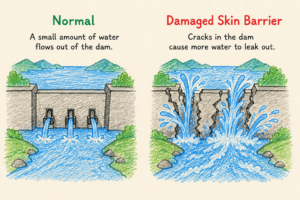
As a result, moisture inside the skin moves toward the skin’s surface faster than before.
Of course, this does not mean that water literally pours out like a waterfall.
The moisture that passes through the skin and reaches the surface
evaporates into the surrounding air in the form of water vapor.
As more and more moisture continues to escape,
the outer skin gradually becomes drier and weaker.
Then the skin barrier becomes even weaker,
and moisture loss increases again.
Eventually,
Skin barrier damage → Increased moisture loss → Dry skin → Further barrier damage → Increased moisture loss
From this point on,
you may begin to experience a skin condition that goes beyond simply whether your skin looks good or bad.
Of course, this does not mean cancer or any specific disease, so please don’t misunderstand.